
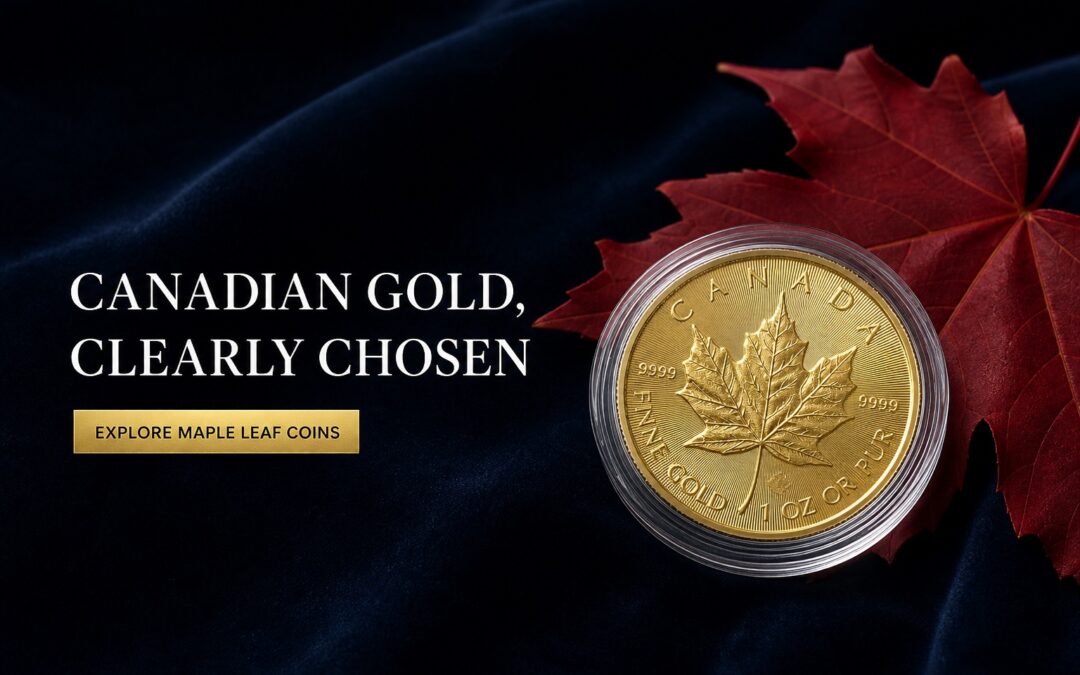
🍁 The Gold Maple Leaf is one of the most widely traded bullion coins on earth, which is exactly why shopping for it can feel deceptively simple. Two listings can look identical on screen and still differ in purity year, packaging, security features and premium.
This guide covers what actually matters when you compare Canadian gold coins for sale, so you buy on facts rather than on the prettiest product photo.
Why the Maple Leaf became a global benchmark
Introduced by the Royal Canadian Mint in 1979, the Gold Maple Leaf was among the first bullion coins offered to ordinary investors rather than institutions. Decades of consistent production created something valuable in its own right: familiarity. A dealer in Toronto, Zurich or Singapore recognises the design instantly, and that recognition keeps the coin liquid when you decide to sell.
Purity of 99.99% and what it signals
Since 1982 the standard bullion Maple Leaf has been struck in 99.99% fine gold — four nines, expressed on the coin itself. Some special issues have gone further still. High purity does not make a coin worth more per gram of gold than a lower-purity coin containing the same gold weight, but it does simplify verification and reassures buyers who want no ambiguity about content. A 1 oz Canadian Maple Leaf contains one full troy ounce of fine gold, not one ounce of alloy.
One practical consequence: pure gold is soft. Four-nines coins scuff more easily than harder alloyed coins, so handling and packaging deserve real attention.
Radial lines, micro-engraving and other security marks
The Mint introduced a micro-engraved security mark on the one-ounce Gold Maple Leaf in 2013 and added precisely machined radial lines to later issues. The tiny maple leaf security mark carries the final two digits of the mint year and is visible under magnification. These details are difficult to reproduce convincingly, but the exact feature set depends on denomination and year, so compare a coin with the Royal Canadian Mint specification for that issue.
Check the year before you judge the coin
Earlier coins predate these features entirely. An older Maple Leaf without radial lines is not suspect; it is simply older. Judge each coin against the specifications for its own mint year, not against the newest release.
How to buy Canadian gold coins without guesswork
Most buyer regret traces back to skipping one of five checks.
- Confirm the exact product. Weight, mint year (or “our choice of year”), and whether the coin is a standard bullion strike or a special issue.
- Read the premium, not just the price. Ask what you pay above metal value.
- Check condition and packaging. Sealed capsule, mint tube, assay card, or a loose coin described as circulated-condition bullion.
- Confirm authenticity practice. How does the seller verify inbound coins, and what happens if something is disputed?
- Understand delivery and storage. Insurance, discretion, signature requirements and tracking.
Gold coin values in Canada: spot plus premium
Every bullion transaction has two components. The first is the metal value — the live spot price of gold multiplied by the coin’s fine gold weight, adjusted into your currency. Spot moves continuously, so no article can quote a fixed figure. The second component is the premium: the dealer’s margin plus minting, distribution, insurance and handling costs.
When people research gold coin values Canada-wide, they are usually really comparing premiums, because the metal portion is broadly the same everywhere. Premiums move with demand, year availability and packaging, which is why a sealed current-year coin and a scuffed secondary-market coin of the same weight can carry different prices while holding identical gold.
| Consideration | Sealed current-year bullion | Secondary-market coin |
|---|---|---|
| Typical premium | Higher — reflects fresh mint supply and packaging | Often lower — depends on stock and condition |
| Condition | Untouched in capsule or tube | May show handling marks; gold content unaffected |
| Security features | Radial lines and micro-engraving where applicable | Varies by mint year |
| Best suited to | Gifting, long-term holding, presentation | Cost-focused accumulation by weight |
| Resale friction | Low — packaging supports inspection | Low — recognition still drives liquidity |
Bullion or collectible? Decide before you buy
Standard bullion Maple Leafs are bought for gold content, priced close to metal value, and sold the same way. Collectible and numismatic issues — limited mintages, proof finishes, special privy marks — carry a value that also depends on rarity, grading and collector appetite. That market can reward patience, but it is a different discipline with a wider spread between buying and selling.
If your goal is simple metal ownership, standard bullion keeps things clean. If the design and history draw you in, collectibles are legitimate — just buy them knowing which market you are entering.
What a careful seller should offer
- ✅ Verified stock Coins inspected on intake, described honestly by year and condition.
- 🔒 Discreet packaging Nothing on the outer parcel advertising the contents.
- 📦 Insured shipping Tracked, signature-required delivery on every order.
- 💬 Reachable people Straight answers before you commit, not after.
That last point is underrated. When buyers ask where the best place to buy Canadian Maple Leaf gold coins is, the honest answer is less about any single feature and more about whether the seller states clearly what is in the box, what it costs above spot, and how it will reach you.
Frequently asked questions
Is a 1 oz Canadian Maple Leaf a good starting point?
It is a common first purchase because pricing is transparent, recognition is global, and one troy ounce is an easy unit to track. Smaller fractional sizes exist and carry proportionally higher premiums per gram of gold.
How do I know a coin is genuine?
Confirm weight and diameter against the specifications for that mint year, inspect radial lines and micro-engraving where the year includes them, and buy from a seller who verifies coins on intake and documents what they sold you.
Do scratches reduce the value of bullion?
For standard bullion, minor handling marks do not change the gold content and usually have little effect on what the coin trades for by weight. Presentation matters far more for collectible issues, where condition and grading are central.
Should I remove the coin from its capsule?
Generally no. Four-nines gold is soft and marks easily, so leaving coins sealed protects surfaces and makes future inspection simpler. If you must handle a coin, hold it by the edge over a soft surface.
Why do listings for canada gold coins for sale differ in price?
Differences usually come down to mint year, packaging, condition, stock levels and the seller’s premium — not the underlying gold, which is the same troy ounce in every case. Compare the premium over spot to compare fairly.
Ready to choose your Maple Leaf? 🍁
See current availability, mint years and packaging on our gold coin range — with insured, discreet delivery on every order.
Shop gold coins
Questions about a specific year or quantity? Contact our team and we will talk you through it.
Please note
Coin specifications, purity marks and anti-counterfeiting features vary by mint year and issue, so always confirm details for the specific coin you are buying. This article is general information only and does not quote live prices, predict future values, or guarantee any investment outcome.